

The global energy transition faces a fundamental challenge: meeting growing demand while reducing environmental impact. Renewable energy adoption must first overcome challenges with scaling and infrastructure to grow worldwide.
Robert Murphy, CEO of Othersphere, believes solving this puzzle requires location-specific, data-driven insights that make new energy projects financially viable. “If it’s not cheap enough to compete in the market, it won’t grow,” Murphy explains.
Othersphere equips developers with advanced analytics to identify optimal locations for sustainable infrastructure. By modeling millions of locations around the world in parallel, they’re solving the energy demand challenge, providing insights that help users soundly and profitably scale their projects.
Growing up in Calgary and the Middle East, Murphy has always been around the oil and gas industry, giving him a deep appreciation for energy’s complexity. “Energy underpins everything we do in a way a lot of people appreciate and a lot of people don’t sometimes understand,” Murphy notes. “It’s economics, science, geopolitics, social factors all at once.”
His career path through Washington DC policy circles, renewable energy consulting, and corporations like Chevron provided crucial perspective. Each experience reinforced the importance of financial viability in scaling sustainable solutions.
“Seeing the reality that these lower carbon, climate-compatible solutions have to make financial sense to be sustainable in the broader sense of the word was critical,” Murphy reflects on an early career setback during the 2008 financial crisis.
Seeking to strike a balance between profitability and sustainability, Murphy took his understanding of the industry, policy, and data to the startup private sector. By leveraging his previous experience, he built Othersphere, unlocking the economic power of accessible data insights for infrastructure development.
Throughout his career, Murphy noticed a persistent problem: energy infrastructure development relied on outdated tools and processes. “At Enbridge, for example, building renewable energy assets or pipeline systems and analyzing where they would go, we were doing it in quite an archaic way,” he explains.
Traditional methods involved “a mix of Excel and maybe bringing in some GIS tools at some point, but in a pretty ad hoc way.” Worse, industrial planners often use top-down models that assume gradual linear change in technology, missing the changes that are actually occurring on the ground. These inefficiencies sparked the idea for a more data-driven approach to infrastructure planning.
Leveraging previous startup experience and securing initial funding from Breakthrough Energy, Murphy founded Othersphere to systematically identify optimal locations for energy infrastructure. He put together a fresh team to take on the industry’s fundamental challenge: supporting climate goals while also making sustainable infrastructure financially viable.
Othersphere created a spatial economics platform that analyzes millions of potential project locations simultaneously. “We make the ideal location searchable and easy to find,” Murphy explains.
To help project developers and hardware OEMs find sustainable long-term infrastructure, the system evaluates sites based on three criteria: economics, emissions, and fit with local surroundings. This helps them plan in a way that is both climate-compatible and economically sustainable and scalable—seeking opportunities to build high-performance, low/zero GHG projects that minimize any ‘green premium. ’
For commercial developers, this approach revolutionizes the way they identify opportunities. Rather than relying on relationship-driven prospects or limited high-level evaluations, the platform indexes the whole world for infrastructure, providing comprehensive analysis that identifies financially viable locations for development.
The company’s Explorer tool delivers these insights through an accessible interface that serves various stakeholders. “We’ve tried to make it so that anyone in an organization can come in and start to understand and digest these insights,” Murphy notes. This accessibility helps align financial, technical, and community teams around optimal project locations.
Their first target was the hydrogen market, which has extreme potential but faces serious economic realities. “When you look at the green premium for most kinds of low-carbon hydrogen production around the world, there’s not many places where it’s outright just competitive without policy support.”
Using Explorer, developers can search the world for potential project sites, assessing financial fits down to the individual location. There, they’ll find a scatter plot of the levelized cost of hydrogen and carbon intensity of dozens of production pathways for hydrogen at that site.
Developers can then take this accessible, exportable data back to their teams to kickstart the project financing process with greater confidence. “We’re basically running billions of project models in parallel,” Murphy explains. “You can pull them out as Excel files, and they are basically in the form you could take off to the project finance firm.” This holistic data means reduced perceived risk from any potential investor.
The result is quicker movement through the financial stage and shorter project timelines. “The idea is to help the downstream stakeholders understand project risks and get more comfortable with them more quickly because a lot of resistance to fund projects is driven by the perception of risk as much as the actual risk,” Murphy says.
Othersphere’s next target is the more complex market of data centers. With the boom in AI and the vast amounts of energy required to sustain the industry’s growth, development requires extensive commercial modeling and GIS work.
For these more complex use cases, Explorer streamlines the project analysis to provide insights into today’s energy economy—and tomorrow’s. Murphy says, “We’re showing them how to identify all the right criteria for location selection—not just where is a good place to build today, but where it will be a good place to build tomorrow.”
For data centers, factors such as energy availability, cost, and carbon intensity are well-known factors in project viability. But projects are also dependent on lower-profile factors such as temperature variability. Even a minor 1-2 degree change over the long term will have a meaningful impact on operations and how developers plan for cooling costs. These factors also determine the cooling systems they install at the outset.
This foresight could save project developers millions in costs, all through Othersphere’s platform. “We’re trying to give these organizations planning superpowers just without having to invest a huge amount of time, people, and data expenses in the process,” Murphy explains.
Looking toward the future of clean tech, Murphy sees Othersphere as empowering developers to build a profitable and sustainable future. “Our role is supportive,” Murphy emphasizes. “We’re trying to shape the tools industry uses and the lens they look at in terms of what success looks like.”
As technology improves and development evolves, Murphy sees two potential paths for infrastructure growth in the 22nd century. The optimistic scenario involves solving clean tech’s fundamental problem, efficiently providing material prosperity globally while minimizing environmental impact: “How much omelet can we make while breaking the fewest amount of eggs?”
The alternative resembles business as usual, where development proceeds inefficiently and many areas miss opportunities for advancement. Without widespread access to data, developers remain stuck to ad hoc models, leading to inefficiencies and missed opportunities
Murphy believes Othersphere can help steer toward a better outcome by providing tools for large-scale optimization, ultimately leaving a positive mark on local communities. He notes, “I feel that a project should benefit the local community as much as its end users. “
Beyond economic considerations and global trends, Othersphere creates meaningful positive change that transforms the planet for the better. “What kind of world do we want to live in—and leave for our kids and their kids going forward? A lot of that goes back to the tools and the priorities we set today,” Murphy reflects.
Robert Murphy’s experience across the energy sector has crystallized into a clear vision: data-driven decisions are essential for addressing global energy challenges. Through Othersphere’s spatial economics platform, developers can identify locations where industrial and energy infrastructure makes financial sense while meeting environmental and community needs.
Whether a global developer or a commercial property owner, taking a data-driven approach to energy infrastructure is the way to effectively evaluate opportunities. The most successful projects align economic viability with strategic site selection, using comprehensive data to support long-term success.
As Murphy puts it: “We want to provide well-being to everyone, and we need to do it in the lowest-footprint way possible.” By focusing on where projects make financial sense, the energy transition becomes both sustainable and scalable.
Source:
King Energy - https://www.kingenergy.com/blog/profitable-sustainability-w-robert-murphy/
Original data source:
Spatial coverage:
Visibility:
Methodology:
Download:
License:
The data provided herein is made available on an "as-is" basis, without warranty of any kind, either expressed or implied. The provider does not guarantee the accuracy, completeness, or usefulness of the information. By downloading this data, the user acknowledges that the provider shall not be held liable for any errors, inaccuracies, or omissions in the data, nor for any damages, losses, or consequences arising from the use, misuse, or reliance on this data. The user assumes full responsibility for the use of the information provided and agrees to use it with caution and at their own risk.
How long should it take to learn whether a site deserves a second look?
For most infrastructure teams the answer is still weeks. Research is scattered and manual, and the first red flag often appears after real money has been spent.
Today we are releasing the beta of Scout, at scout.othersphere.io, a public app to screen infrastructure sites anywhere in the world. Choose an asset type, choose a location, and instantly see an initial screen of its viability.
Othersphere exists to optimize the deployment of high-performance infrastructure worldwide. Our platform indexes more than 60 datasets to over 180 million locations, and models each one from the bottom up.
Until now, that work has mostly reached people through our Explorer software and our full site assessments. Scout opens a narrow view of the same derived data to anyone who wants to look.
Scout has three steps:
The beta launches with two asset types: data centers and utility-scale solar PV.
Scores are for a generalized version of each asset type. Project details, such as the size of a solar facility or the power supply goals of a data center, would shift how factors are weighted.
Weighting is a judgment, not a measurement, and different stakeholders will weigh the same factors differently. A few constraints are severe enough to be deal-breakers, which set the overall score to zero.
Scout shows topic scores and not the underlying values, because much of the data behind them is licensed. The FAQ in the app explains how the score is built.
Scout is deliberately light. It scores dozens of data topics indexed to each ~0.7 km² tile, which is enough to decide where to look harder. A full site assessment is where that harder look happens.
A full assessment adds factors the global screen leaves out entirely, such as community sentiment and permitting, along with detail on labor availability, zoning, and incentive programs. It works at the level of the individual property, confirms and refines the screening data with hyperlocal research, and ends with comprehensive scoring and a go/no-go recommendation.
Assessments typically run 100-150 pages of fully cited analysis and arrive in three days or less. They are available today for data centers and now utility-scale solar PV.
In the months ahead we will keep adding asset types to both Scout and our site assessments. Onshore wind and BESS are next in line based on feedback so far, and we want to hear which assets matter to you.
So please explore the globe and share it as you see fit. Scout is in beta ahead of its formal launch, and your comments will shape what we add.
If you need detailed diligence at a location you choose, request it through the app or reach us at explore@othersphere.io.
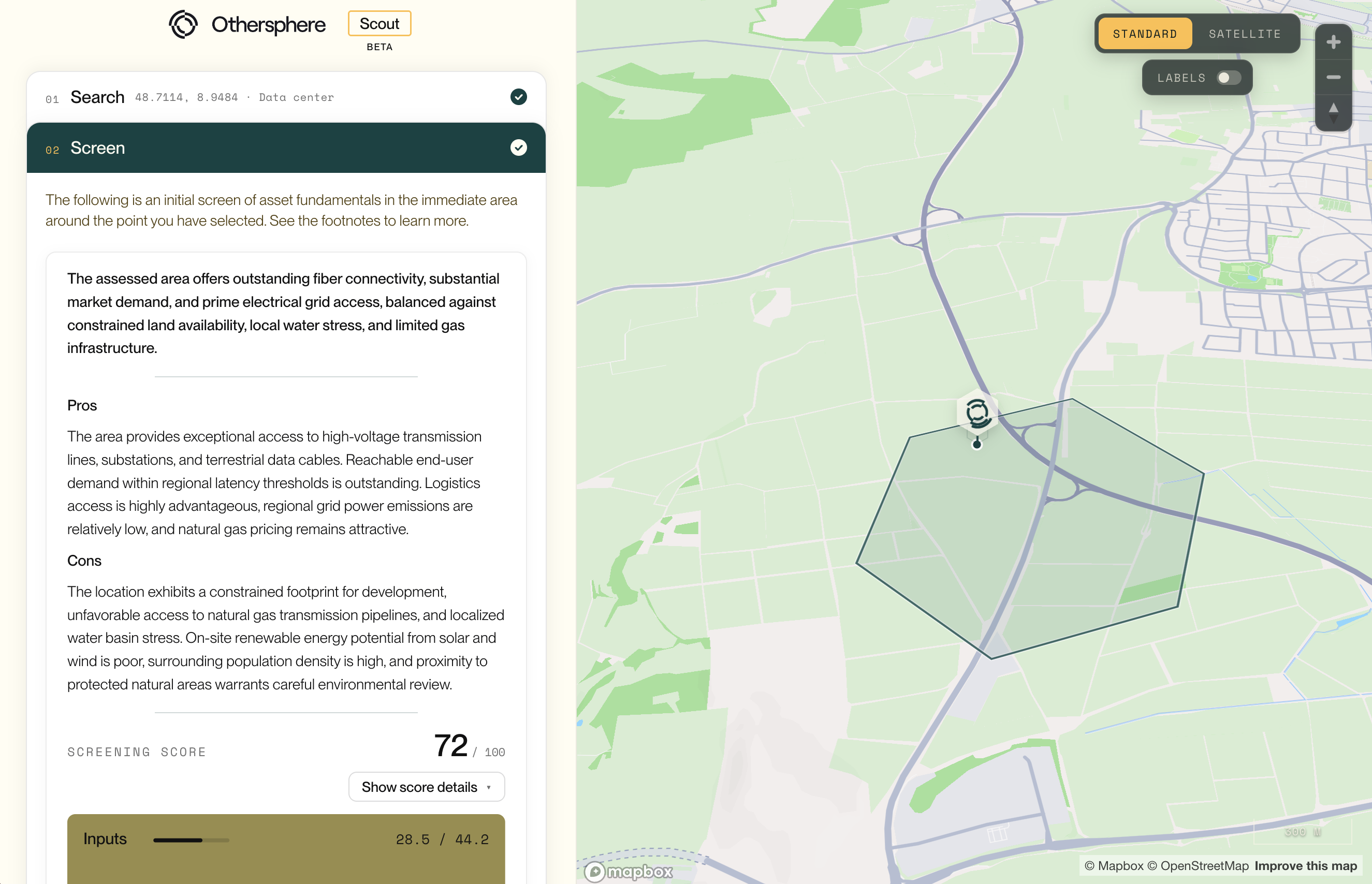
How long should it take to learn whether a site deserves a second look? For most infrastructure teams the answer is still weeks. Research is scattered and manual, and the first red flag often appears after real money has been spent. Today we are releasing the beta of Scout, a public app to instantly screen infrastructure sites anywhere in the world.

What decides whether a utility-scale solar project gets built? It is never just the sun, as projects more often stall on grid queues, planning risk, land encumbrances, and local opposition, and those tend to surface after weeks of research and spend.
Today Othersphere site assessments are generally available for utility-scale solar PV. Each one delivers detailed, fully cited diligence on a location you choose, in three days or less.
We released site assessments for data centers earlier this year, and teams have since used them across North America, Europe, Asia, and Oceania. Solar PV is the first expansion of that coverage.
The method is the same. Our platform indexes more than 60 datasets to over 180 million locations. An AI research system then investigates the local detail that global data cannot hold, reviewing thousands of documents, webpages, and videos. Our team reviews the result before delivery.
Assessments typically run 100-150 pages. Each one has four parts:
An optional module adds asset-level financial analysis, using our models or yours.
This sample assessment covers roughly 27 MWp of solar on farmland near Retford in the United Kingdom. It scores 61.4 out of 100, with a recommendation to advance with conditions, across 143 pages and 477 cited sources.
The solar resource is viable and the logistics are exceptional. The findings that decide the project sit elsewhere:
The assessment closes with four specific actions to take before committing more capital, from a grid connection application to a topographical survey.
Slow diligence limits pipeline quality, because a team can only look closely at a few sites. With a full assessment in days, developers can vet more locations and drop the weak ones before paying for options, surveys, or consultants.
For operators and financiers, the same report gives a cited view of project fundamentals before capital is committed. Across our assessments, teams reach decisions in 95% less time.
An assessment does not replace surveys, title searches, or professional advice. It tells you which of them to commission first, and which sites do not merit the expense.
The quickest way in is Scout. Select utility-scale solar PV, screen your location, and request a full assessment from within the app. A request is not an order; we follow up to confirm the location and asset configuration first.
You can also reach us directly at explore@othersphere.io.
Onshore wind and BESS are next in line for both Scout and our site assessments. If there is an asset type you need sooner, please tell us.
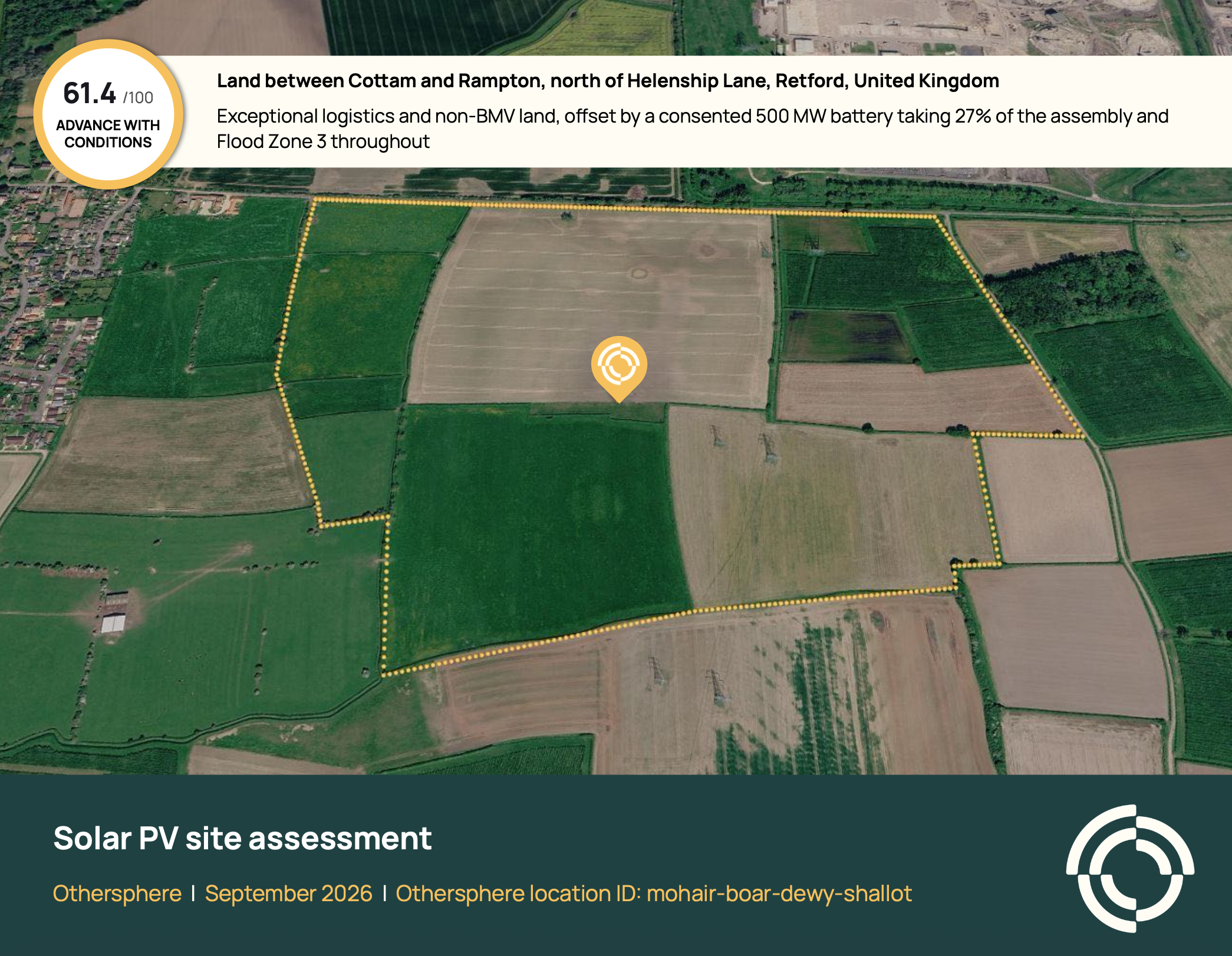
What decides whether a utility-scale solar project gets built? It is never just the sun, as projects more often stall on grid queues, planning risk, land encumbrances, and local opposition, and those tend to surface after weeks of research and spend. Today Othersphere site assessments are generally available for utility-scale solar PV. Each one delivers detailed, fully cited diligence on a location you choose, in three days or less.
Please reach out if you would like to learn more about Othersphere, our products, and opportunities to partner in accelerating deployment of high performance, sustainable infrastructure.


